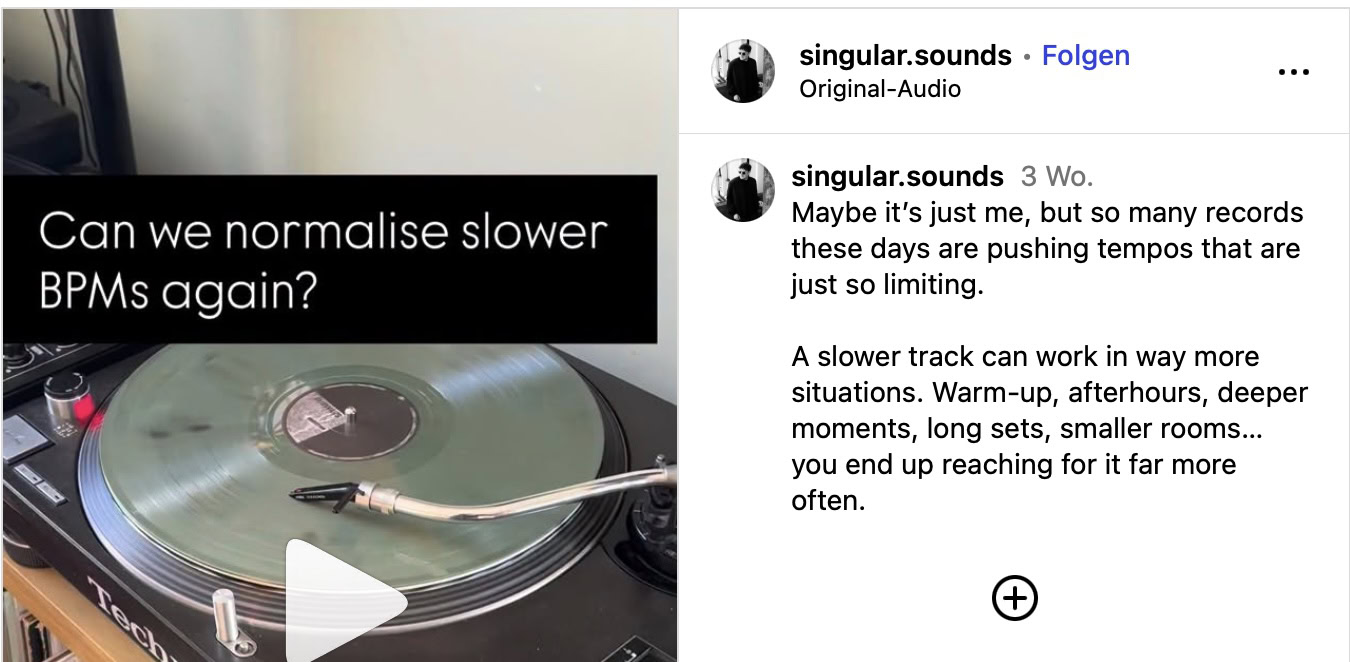
A few weeks ago I stumbled upon an Instagram reel by @singular.sounds, playing an fast techno track.
The corresponding caption reads:
“Can we normalise slower BPMs again? 140+ should be the exception”
He pitches the record down by -8, stating that there’s now more space and groove in the music.
I wrote a comment saying: “At some point, the groove is lost at higher tempos”
The post got over 20k likes, and my comment alone got more than 2k.
Nevertheless my comment received a few replies, defending higher BPMs (beats per minute) in techno.
In hindsight, I’m not so sure anymore whether my comment really reflects the truth. That’s why I’d like to devote this article to the topic of groove and (faster) tempos.
Screenshot
What is groove anyways?
Groove refers to the rhythmic feel that makes music compelling, danceable, and emotionally engaging.
Different genres have signature groove feels (straight 16ths in funk, swing in jazz, dotted rhythms in reggae, etc.)
Yes, groove is absolutely possible at higher tempos – but it behaves differently and often requires different techniques to maintain that irresistible, locked-in feel.
Take Jazz for example:
Up-tempo swing ranges somewhere between 200-300+ BPM. The ride cymbal keeps a swinging feel even at blazing speeds.
Or let’s have a look at Drum & Bass that ranges between 160-180+ BPM. The groove comes from the interplay between fast hi-hats, breaks, and heavy half-time kick/snare-patterns.
The thing is:
Different groove pattern work best within particular BPM ranges
With higher tempos microtiming becomes tighter.
The tiny pushes and pulls that create groove have less room to breathe. What feels like a nice roller at 130 BPM can sound rushed or stiff at 160+ BPM.
At faster tempos other subdivisions are needed to keep the groove from sounding frantic (e.g., playing eighths instead of 16ths).
@m29_music, the artist behind the track played in the Instagram Reel I mentioned, admitted in his comment:
I produced this track. I totally understand your point and I kinda agree with you as it’s not the bpm range I normally produce or play when it comes to techno.
This was more like an exercise and experiment to see how far I could go with this fast dub techno style. Interesting to see it started a whole discussion.
That said, there’s plenty of slower dub techno tracks, I don’t know much more fast tracks besides some from LDS and I think it’s fun to do something different sometimes. Play it at the speed you enjoy the most!
This shows that it’s not the faster tempo per se that undermines groove.
Another important point:
Tempo and energy aren’t the same thing
The first track that came to my mind to prove this claim was Vril’s “We believe”.
This heavy stomper sounds massive while sitting comfortably at 127 BPM.
Another great example: Len Fakis all-time classic “BX3”.
In my opinion, this is one of the best techno tracks ever made. It’s full of energy from start to finish, and it works well as is running at a comparably slow 125 BPM (but feels faster).
At 134 BPM, Rene Wise’s “Complicated” unfolds with a somewhat different groove. It’s one of my favorite techno tracks of recent years.
It seems like my choice of three techno tracks in a range between 125 and 135 BPM might not be a coincidence.
There’s some evidence that this could be the best range for Techno, even from a scientific standpoint.
BPM, heart rate and the physiology of dancing
Our cardiovascular system and movements naturally tend to align with the music’s tempo. This phenomenon is called entrainment.
When dancing to club music, the steady kick drum and repetitive rhythms prompt our heart rate, breathing, and steps to match or approach the BPM.
It elevates heart rate into a cardio-like “training” zone while dancing.
A tempo above 140 beats per minute accelerates heart rate more aggressively, increases excitement, and mimics higher-intensity cardio.
This is why hard techno sets feel more physically demanding.
Fitter dancers can handle higher BPMs with less relative strain, which might explain why especially younger people are drawn to hard techno these days.
There’s no right and wrong
Ultimately, it’s just a matter of personal preference. Listen and party to what feels right to you!
For me, anything over 140 BPM feels simply too fast.
And in the 120–140 BPM range, I’m also very picky about what I like and what I don’t. The tempo doesn’t really matter here, but the vibe of the track does.
In my view, all discussions about whether a piece of music can be techno if it’s slower than – let’s say – 130 BPM are pointless.
As if to say: anything below that must be (tech) house.
No, it doesn’t have to be.
I hardly ever judge whether something is more house or techno based on the tempo. Instead, I look at the vibe and how the track is produced.
Live and let dance!